Why can't I just have no grout at all?
The most common showroom request, and the answer explains almost everything about how tiles are made. Here are the three reasons no grout cannot work.
By OnWood Tiles
It is the most common request we hear in the showroom, and the answer explains almost everything about how tiles are made. You have found a tile you love, you can picture it as one unbroken surface, and the grout lines look like the only thing in the way. So why not push them together and be done with it?
There are three reasons, and each one tells you something worth knowing about the tile in your hand. None of them is a rule invented to sell you more grout. They come straight out of how a tile is fired, how a floor lives, and how a building is actually built.

Because no two tiles are the same size
Firing shrinks a tile, and not by an identical amount every time. A pressed tile leaves the kiln at roughly its nominal size, which is why boxes carry calibre numbers. Those numbers group tiles that came out close enough to lay together, and it is also why mixing calibres causes so much grief on a floor.
Push those tiles hard together and the variation has nowhere to go. Your joints wander visibly across the room, tight in one place and open in the next. This is where rectification comes in. A rectified tile gets one extra step after firing: the edges are mechanically ground square and true to an exact dimension, so every tile in the box genuinely matches. That precision is what buys you the narrow joint.
As a working guide, rectified porcelain wants a 2 to 3mm joint, while pressed unrectified tile wants 3 to 5mm. The joint is most of what you are actually looking at. One display reads as a continuous surface, one reads as a grid, often in the very same colour, and the difference between them is the joint, decided by whether someone ground the edges.
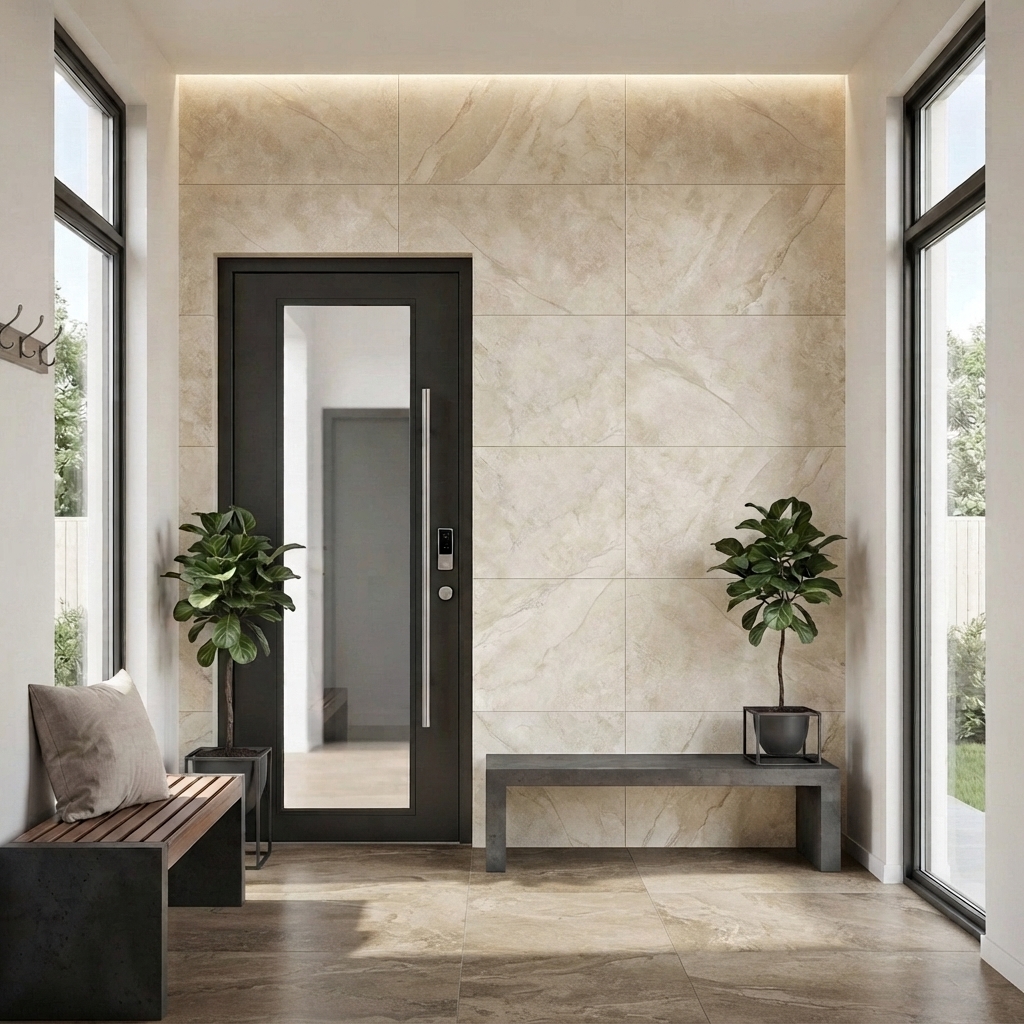
The honest version of what you want is not no grout at all. It is a 2mm joint in a grout colour matched to the tile.
Because the floor has to move
Tile and substrate expand and contract with heat and moisture, and they do it at different rates. The grout joint is the only thing absorbing that movement across a floor. It is a soft seam sitting between hard pieces, giving them somewhere to go.
Remove it and the floor has only two options: lift a tile, or crack one. This is the problem that goes bang. It is not a slow cosmetic fault that you can live with and fix later. It is a floor running out of room, and when it happens you hear it.

Because buildings are not square
Every wall is slightly out. A good tiler resolves those accumulated errors a fraction of a millimetre at a time, and the joints are where that quiet correction happens. Spread across a room, tiny adjustments in each joint keep the whole floor looking straight and true.
A floor with no joints has no tolerance at all. There is nowhere to hide the error, so it has to surface somewhere, and it surfaces as a wedge-shaped cut against the wall you look at most. The seamless idea ends up drawing your eye to the one line you least wanted to see.
What this means for you
Rectification is not simply better. A ground edge chips more easily in handling and demands a flatter substrate, so it asks more of the tiler and of the floor, and it should be priced accordingly. It is a genuine upgrade, not a free one.
But it is the answer to the seamless look, and the question to ask is simply this: is this tile rectified? From that one answer everything else follows, including how tight the joint can safely go.
The honest version of what you want is not no grout. It is a 2mm joint in a grout colour matched to the tile. From standing height that is indistinguishable from seamless, and it will still be flat in twenty years.
This piece appears in Kiln, our magazine. Flick through it here.
When you are ready, browse our tiles or book a showroom visit.
Written by OnWood Tiles, 16 August 2026